Building Technology That Works at the Margins
War Child Holland is recognised as a leading organisation in the delivery of psychosocial support to children affected by armed conflict. Their work is structured around child-friendly spaces — safe environments where war-affected children can access support, learning, and community.
Among War Child Holland's portfolio of innovation projects, one focuses on strengthening how feedback is gathered from the communities they serve, and how community volunteers who run these programmes are trained. The goal was to move this function to a digital platform — one that could work reliably in the field. War Child Holland approached Made by People to be their design and development partner.
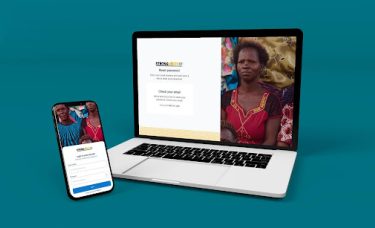
The result was My Voice: a tablet-based feedback and learning platform that helps children participate in their own programme evaluation, equips community volunteers with training content, and automates attendance tracking — all in an environment characterised by low literacy, linguistic diversity, limited connectivity, and minimal access to technology.
"The goal was not to build something technically impressive. It was to build something that actually worked for the people who would use it — in one of the most constrained environments on the continent."
Understanding the Environment
Before any design or development work could begin, Made by People needed to develop a clear picture of the environment the tool would operate in. Malakal, South Sudan presented a set of constraints that would shape every decision in the project.
Technology access in the communities War Child Holland worked with was limited. Where devices existed, they were typically shared across multiple households. Literacy rates — both written and spoken — were very low among the target users, which meant a text-heavy interface would immediately exclude the people the tool was designed to serve. The communities also spoke a different language from the development team, requiring the tool to be fully localised. And connectivity was unreliable: the solution had to be functional in low or no-internet conditions.
These were not edge cases to be designed around. They were the design brief. Made by People's approach began by treating these constraints as the primary frame of reference for every subsequent decision.
UX Research in Malakal
Made by People deployed a team of researchers with established experience conducting user research in low-income and conflict-affected contexts. Working in Malakal, the team used a combination of focus groups, structured interviews, and direct observation to build a grounded understanding of users' needs, behaviours, and constraints.
The research was conducted with careful attention to the cultural sensitivities involved in carrying out field work in a country experiencing active conflict. The team worked with local partners to ensure the process was appropriate, respectful, and genuinely informative.
Three findings from the research carried particular weight. First, shared access to technology was the norm — the tool would need to accommodate multiple users on a single device without relying on individual accounts or persistent logins. Second, the low literacy levels among both children and community volunteers meant the interface would need to rely on visual and audio cues rather than text. Third, language localisation was not optional: a tool in the wrong language would simply not be used.
These insights formed the evidential foundation on which all subsequent design and development decisions were built.
Ideation: Generating and Narrowing Solutions
With a clear picture of the user context established, Made by People moved into ideation — a structured process of generating a wide range of potential solutions before narrowing to those most viable, impactful, and implementable within the project's constraints.
The ideation process involved multiple brainstorming sessions with the War Child Holland team. Made by People developed user stories and use cases to frame the problem space, and created user personas to anchor the team's thinking in the real needs and motivations of the target users: the children participating in the programme and the community volunteers running it.
Among the ideas generated and evaluated were:
- A feedback tool for children to rate their experience in child-friendly spaces, designed to be usable without requiring literacy
- A learning tool for community volunteers covering how to identify and respond to violations of international humanitarian law
- An automated attendance register for child-friendly spaces
- An SMS-based reporting system for humanitarian law violations
- A mobile application for reporting violations via smartphone
- An interactive map showing the location and available resources at each child-friendly space
Each idea was evaluated against three criteria: viability (could it be built within the project's scope), impact (would it meaningfully serve the target users), and implementability (could it work reliably in a low-connectivity, low-literacy environment). Through multiple rounds of evaluation and selection, the team arrived at a focused set of features that became the core of the My Voice platform.
Application Development
With the design direction defined by research and refined through ideation, Made by People moved into development. The My Voice platform was built as an Android application designed for use on tablets, with a web-based management dashboard for War Child Holland's programme teams.
The development process was oriented throughout by a clear priority: make the application genuinely usable by people with low literacy levels, limited technology experience, and no reliable internet connection. This shaped specific technical decisions — the app was designed to be lightweight and compatible with low-specification Android devices, and was built to function in offline conditions.
The user interface was developed to rely on visual aids and audio rather than text wherever possible, reducing the literacy barrier at every interaction point. Language localisation was built into the architecture from the start, rather than applied as an afterthought.
Technology Stack
| Learning & Feedback App | Android (Java, XML) |
| Management Dashboard | Laravel, HTML5, JavaScript |
| Deployment | Amazon Web Services |
| Database | MySQL |
Usability Testing
Usability testing was conducted in two rounds, both carried out in Malakal with participants drawn from existing War Child Holland programme communities — the same populations that would use the tool in practice.
The first round tested an early prototype with a small group of users. Participants were asked to complete a set of tasks while the team observed their interactions with the application, noting where confusion arose, where the interface broke down, and where the experience created friction. The findings from this round informed a set of design and functionality revisions before testing resumed.
The second round tested the revised version with a larger group in a different location, using scenarios designed to simulate realistic usage conditions. Again the team observed behaviour and gathered structured feedback, using the findings to make further refinements.
The usability studies surfaced a number of specific challenges. Navigating the interface was not intuitive for users encountering touch-screen technology for the first time. Entering text using a tablet keyboard was particularly difficult for users working in a second language. Connectivity limitations in the area required the team to revisit the app's offline functionality and data-handling approach. Each of these challenges was addressed through design iteration informed directly by what the testing had revealed.
One important outcome of the testing process was the introduction of voice input as a data-entry mechanism — a direct response to the difficulty users experienced with the keyboard. This kind of user-led design refinement is only possible when testing is conducted with real users in their real environment, rather than simulated in a controlled setting.
"Usability challenges spotted early in the field are cheap to fix. The same challenges discovered after launch are not. Testing in Malakal, with the actual users, was not optional — it was where the real design work happened."
Outcomes
The My Voice platform was completed and piloted between January and May 2019. The platform delivered three core capabilities for War Child Holland:
- Feedback tool: a mechanism for children participating in the programme to provide feedback on their experience in child-friendly spaces, using a visual interface designed to be accessible without literacy
- Learning tool: training content for community volunteers covering how to run programme activities effectively and how to identify and respond to violations of international humanitarian law
- Attendance register: an automated system for capturing attendance data at child-friendly spaces, removing a manual administrative burden from programme staff
The project's outcomes extended beyond the initial engagement. Following the pilot, other NGOs working in South Sudan joined War Child Holland to form a consortium supporting continued development and wider adoption of the My Voice platform. The project moved into a second phase, with the tool being adapted and expanded based on the learning from the pilot.
What This Project Demonstrates
The My Voice case study illustrates several principles that Made by People brings to every engagement, and that are particularly visible when the stakes are high and the constraints are extreme.
Human-centered design is not a luxury reserved for well-resourced contexts. The process of conducting field research, building empathy with target users, generating and evaluating ideas against real-world constraints, and testing iteratively in the environment where a product will actually be used is exactly the process that produces tools people can genuinely adopt. In Malakal, that process produced a platform that functioned for children who had never used a touchscreen, in a language that was not their own, in a region with no reliable internet.
The alternative — designing from assumptions and testing in a controlled environment — produces tools that fail silently in the field. The investment in research and testing is not an additional cost. It is what separates products that achieve impact from products that don't.
Work With Us
Made by People has been applying human-centered design thinking across Africa for over a decade, working with development organisations, NGOs, and social enterprises to build products and services that work for the people they are meant to serve — including in the most constrained and under-served contexts on the continent.
If you have a challenge that conventional approaches have not solved, we would like to talk. Reach out at hello@made.ke.